
Twice Baked Potatoes

4 servings
NEW

Did you know that twice-baked potatoes are one of those great sides that can almost double as a full meal? Packed with creamy cheddar, parmesan, and fresh chives, my recipe is incredibly easy to make and super cost-effective. We'll bake them until crisp, scoop out the fluffy center to mix into a rich, buttery filling, and bake them again until perfectly golden brown. Let's get cooking and have some fun! Read More

☆☆☆☆☆0x(write a review)👁46x
NEW
90 min.
90 min.
1/5
187 calories Per Serving (of 4) Read More

Before You Start

Let’s talk about important parts of the recipe before you start…

Jump to Recipe

Twice Baked Potatoes, the Way I Make Them at Home

I bake four medium potatoes cut in half, scoop the soft flesh out of the best-looking halves, and turn it into a filling with butter, milk, grated parmesan, shredded cheddar, chopped chives and a clove of grated garlic. That filling goes back into the potato skins and straight into the oven for a second bake, until the top starts turning slightly brown.

The whole thing takes about ninety minutes, and most of that is the first bake doing its work without you. What I care about in this recipe is the shell: a potato half that holds its shape after you dig it out, with skin that has gone slightly crisp in the oven. Get that right and the rest is mixing and piping.

Why I Bake Eight Halves and Fill Only Four

This is the part of the recipe people miss on the first read. Four medium potatoes cut in half gives you eight halves, but only four of them get filled. After the first bake I pick the four best-looking halves, dig those out carefully so they keep their shape, and then completely dig out the remaining four for their flesh alone, throwing that skin away. The reason is simple insurance: hot potato skin can tear or collapse while you are scooping, and if one of your chosen four breaks up, you have four more sitting right there on the baking sheet as backup. It also means the filling is made from the flesh of all eight halves, so there is plenty of it to pile generously back into the shells.

Wash Them Properly and Dry Them — the Skin Stays On

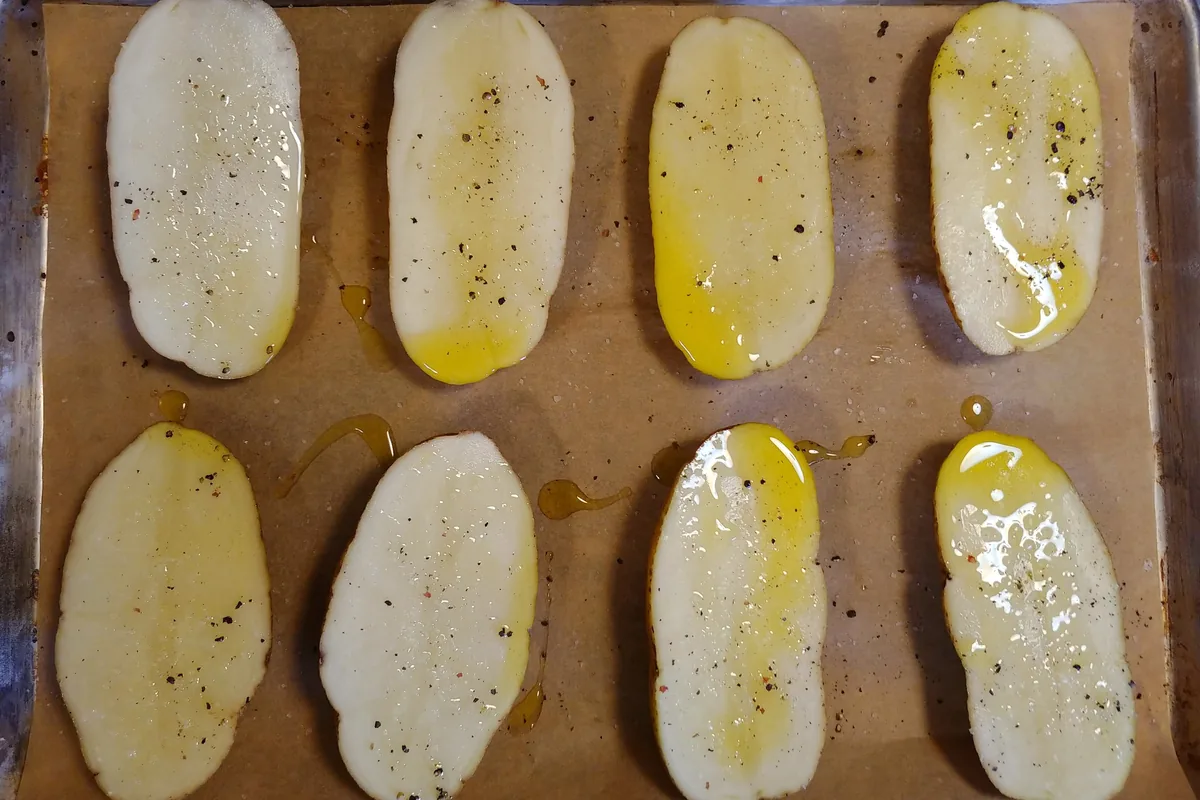
The skin is part of the dish here, so it has to be clean. I rinse the potatoes thoroughly under cold water, scrubbing until there is no grit left, and then I dry them with a kitchen towel before anything else happens. Drying matters more than it sounds: a wet potato does not take the drizzle of olive oil evenly, and the oil is what helps the cut surface and the skin crisp up during that first hour in the oven. Once they are clean and dry, cut them in half with the peel still on, and lay them cut side up on a baking sheet lined with parchment paper or a silicone mat.

Season the Cut Side Generously Before the First Bake

Each half gets a drizzle of olive oil and a generous amount of salt and freshly ground pepper on the cut face. Do not be shy here. This is the only seasoning the skin itself will ever get, and the shell is what you bite through at the end, so under-seasoning at this stage shows up in the finished twice baked potatoes. Freshly ground pepper is worth it if you have a grinder — it is one of those small things that you taste on the surface of a baked potato.

The First Bake: Fork-Tender Flesh, Slightly Crisp Skin

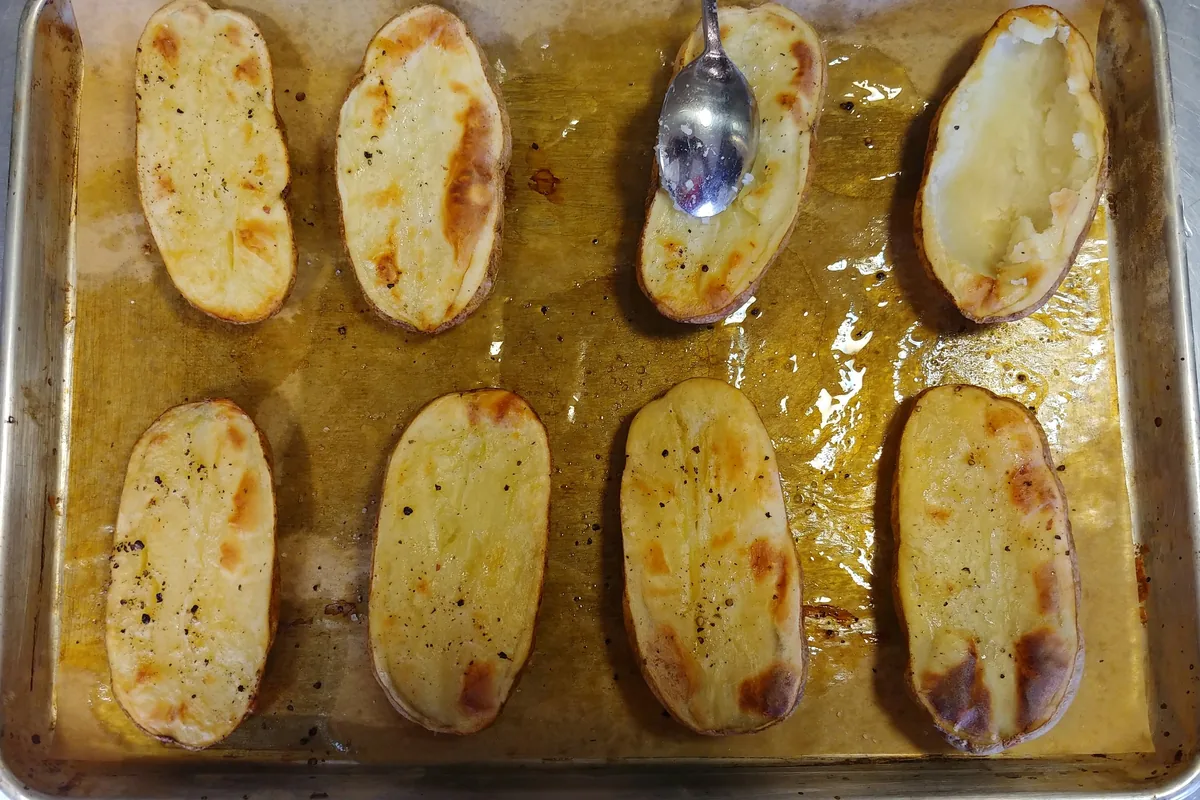
The oven goes to 350°F and the halves bake for about 60 minutes. I am looking for two signals at once: the flesh gives easily to a fork all the way through, and the skins have gone slightly crisp. If the potato is still firm in the middle, it will not mash into a smooth filling and the shell will fight you when you try to dig it out. Give it the time it needs. This is the step that decides whether everything after it goes smoothly, and it is also the step people rush because the potatoes look done from the outside long before they are.

Oven Mitts On While You Dig Out the Potatoes

When the potatoes come out of the oven, leave the oven on — you need it again in a few minutes for the second bake. Then hold each half in an oven-mitted hand and work the spoon around the inside. I say this as a safety instruction, not a suggestion: these halves come straight from an hour at 350°F and they are genuinely hot to hold. Scoop steadily and leave enough potato against the skin that the shell can still hold its shape and stand up on the baking sheet. The flesh goes into a medium mixing bowl, the empty shells go back onto the lined sheet, and then you dig out the other four halves completely and discard their skins.

Building the Filling While Everything Is Still Warm

Into the bowl with the hot potato flesh go 2 tablespoons of butter, 2 tablespoons of milk, half a cup of grated parmesan, three quarters of a cup of shredded cheddar cheese, a quarter cup of chopped chives, one clove of grated garlic, and a pinch each of salt and ground pepper. Mix thoroughly with a silicone spatula until the potato is fully mashed and the mixture is completely combined — no streaks of unmixed cheese, no lumps of potato hiding at the bottom. The warmth of the freshly baked flesh is what melts the butter and loosens the cheese into the mash, which is why I do not let the potatoes sit around and cool before this step. For the garlic, a small hand grater or a garlic press gives you a fine enough texture that it disappears into the filling instead of turning up as a raw chunk.

If the Mixture Fights You, Reach for the Immersion Blender

Some potatoes mash easily with a spatula and some do not. If you are struggling to break the flesh down and the filling is staying stubbornly chunky, give it a short burst with an immersion blender to crush the potatoes, then go back to mixing with the spatula. Keep the blender work brief — it is there to help you past a difficult mash, not to do the whole job. Once the texture is smooth and even, the filling will pipe cleanly instead of clogging the tip.

Pastry Bag or Spoon — Both Work

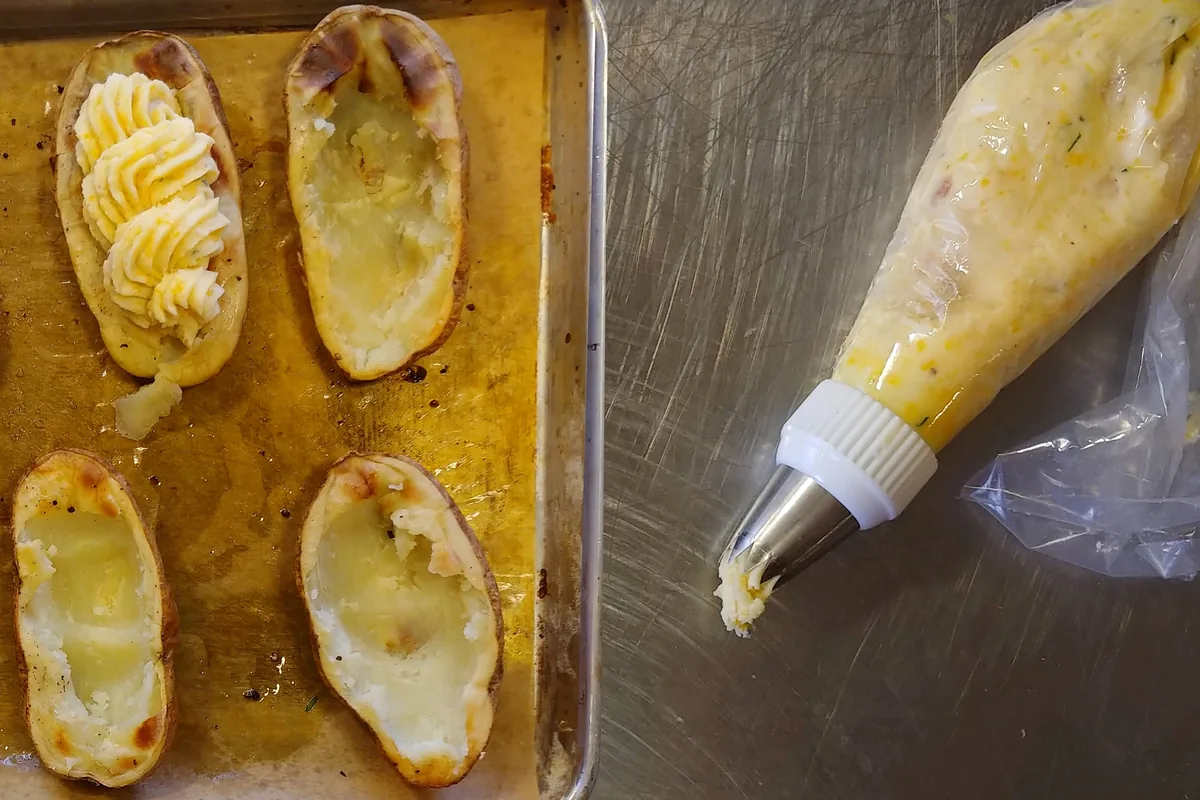
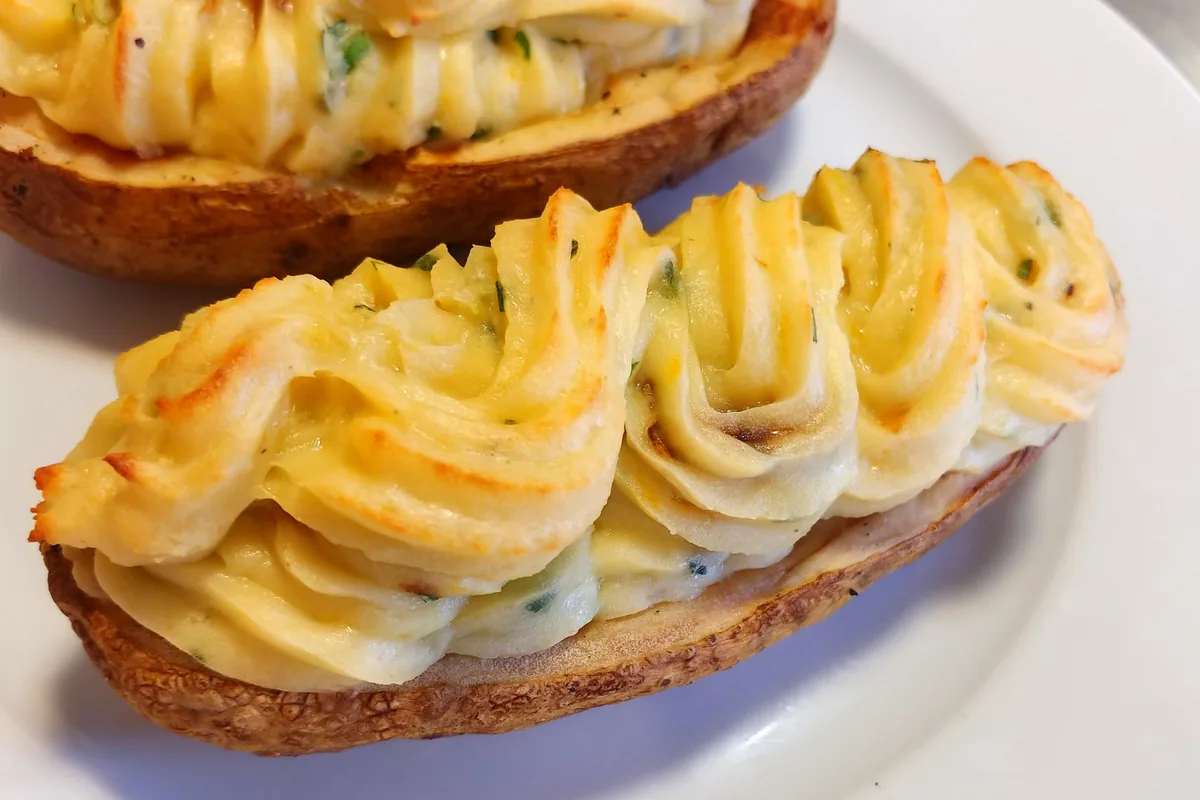
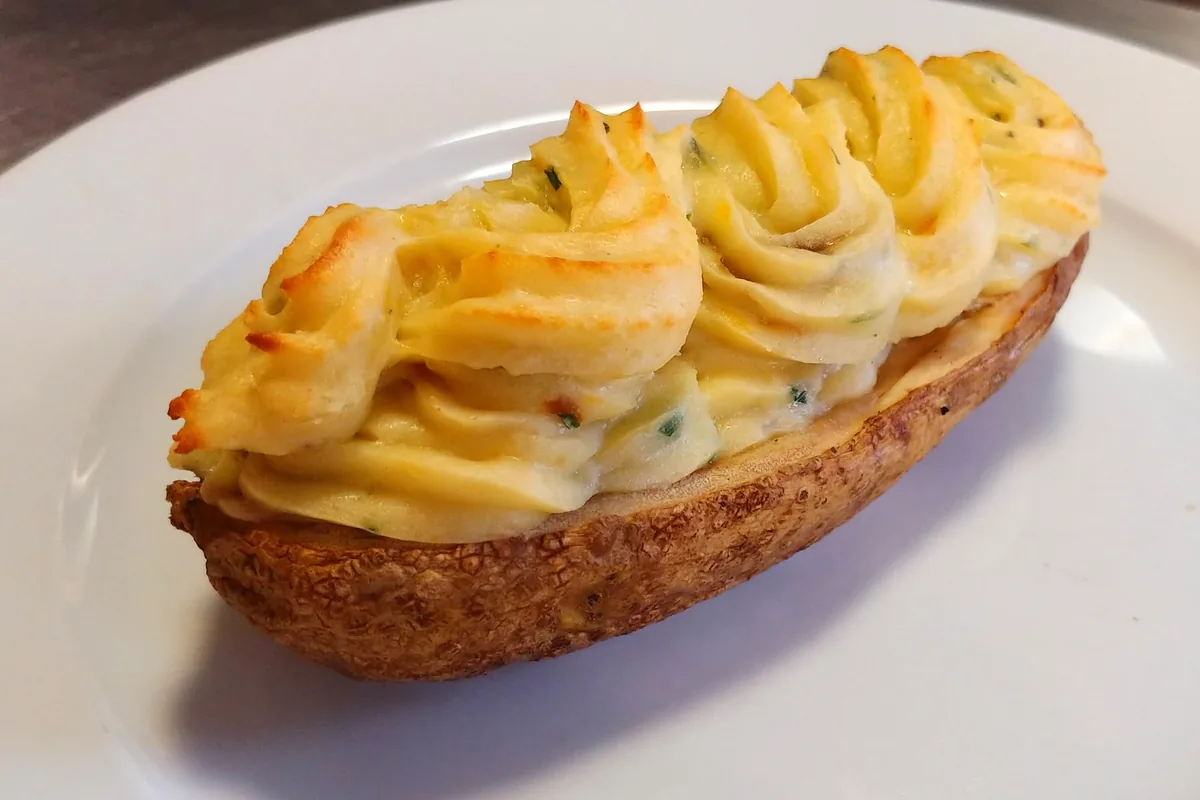
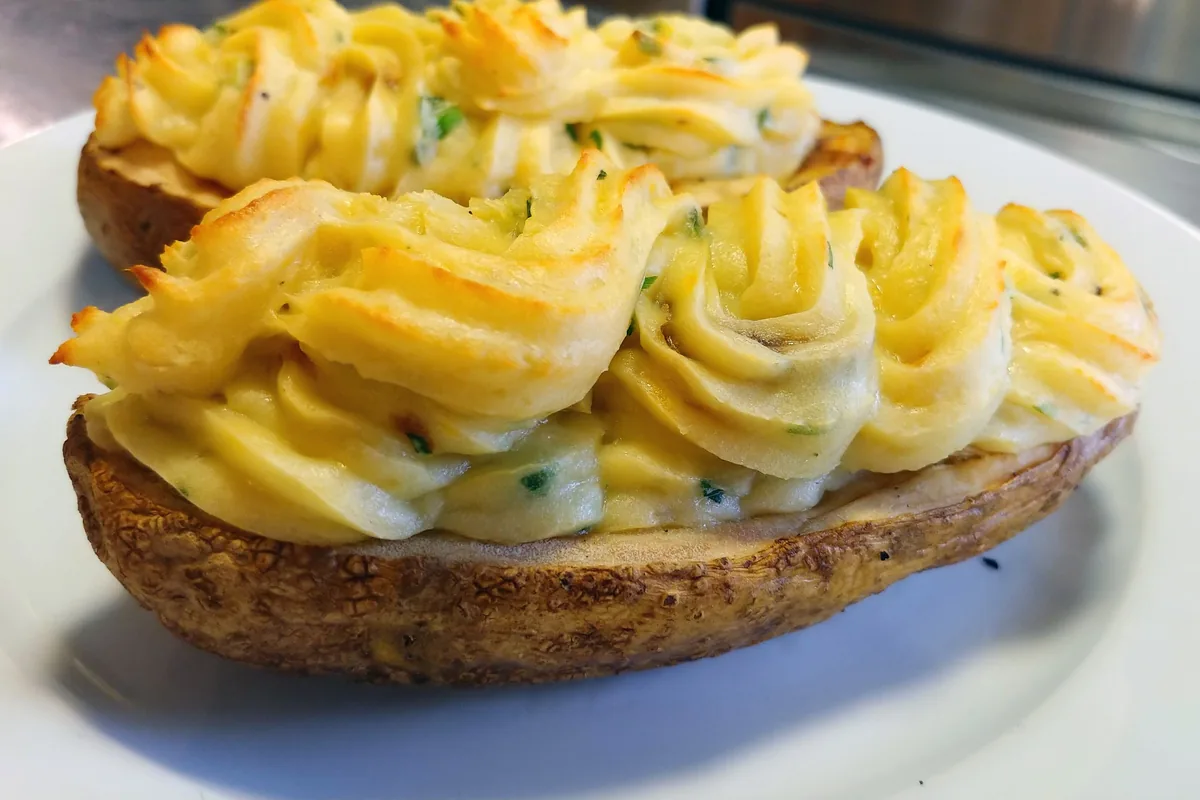
I fill a pastry bag with the potato filling and pipe it evenly into the dug-out halves, which is how these twice baked potatoes get that neat ridged top. A pastry tip makes it look like it came out of a kitchen, and it gives the surface more edges to brown in the second bake. But if you do not have a bag and tips, scoop the filling in with a spoon or a disher instead. The recipe works either way; only the look changes.

The Second Bake and How to Tell It Is Ready

The filled halves go back into the still-hot 350°F oven for about 10 minutes. You are not cooking anything through at this point — the potato is already baked and the filling is warm. What you are after is colour: pull them when the filling starts turning slightly brown on top. That is the whole signal. Watch the surface rather than the clock, especially if you piped the filling with a tip, because the raised edges take on colour first.

Popular questions

What temperature should I set my oven to?

You should preheat your oven to 350°F.

Twice Baked Potatoes

4 servingsNEW ☆☆☆☆☆0x(write a review)👁46x
90 min.
90 min.
1/5
🖨Print

Ingredients:

Click any ingredient to learn more
4 medium potatoes – well rinsed, skin on
Drizzle of olive oil
Pinch of salt
Pinch of ground pepper - ideally freshly ground
2 TBSP of butter
2 TBSP of milk
½ cup of grated parmesan
¾ cup of shredded cheddar cheese (or substitute for other kind)
¼ cup of chives - chopped (or substitute a spring onion or 1 TBSP of dried chives)
1 clove of garlic - peeled and grated

Nutrition per 1 Serving:(recipe split into 4 servings)

Estimated
Calories 187 Protein 8.8 g Fat 15.6 g Saturated fat 9.2 g Carbohydrate 3.3 g Sugars 0.7 g Fiber 0.3 g Sodium 393 mg Cholesterol 44 mg
Estimated. Worked out from the ingredients above using the United States Department of Agriculture’s FoodData Central reference data. An estimate, not a measurement — brands, sizes and how much of a marinade actually ends up on the plate all move it.
Directions:

1.Preparation and First Bake:

Let’s start preparing the twice-baked potatoes!

1.1.

Set the oven to preheat to 350°F.

1.1.1.

Thoroughly wash the potatoes under cold water to make sure that they will be perfectly clean before the next step. Then, dry them with a kitchen towel.

1.1.2.

Cut potatoes in half with the peel still on and place on a baking sheet with parchment paper (cut side up).

1.1.3.

Drizzle with olive oil and generously salt and pepper the top of each potato half.

1.1.4.

Bake in a preheated oven until fork-tender and the skins are slightly crisp (about 60 minutes).

2.Dig Out Potatoes:

2.1.

Remove the potatoes from the oven (but keep the oven on).

2.1.1.
Select the best-looking 4 halves that will be dug out and filled.

Notes:

  • Use the other 4 halves for the flesh only; do not fill them.
  • If some of the 4 you selected break up during upcoming digging up, you have backup options in the extra halves.
2.1.2.
Carefully dig out the center of the 4 best-looking halves using a spoon while placing the flesh into the medium mixing bowl and the empty halves on the baking sheet.

Important:

  • Hold the potato halves with oven mitts while digging them out in order to prevent getting burned.
  • Make sure they can hold their shape after you dig them out.
2.1.3.

Then, completely dig out the remaining 4 halves, place the dug out flesh into a medium mixing bowl and dispose of the skin.

3.Potato Filling:

3.1.
Add to a medium mixing bowl:
2 TBSP of butter
2 TBSP of milk
½ cup of grated Parmesan
¾ cup of shredded cheddar cheese
¼ cup of chives - chopped
1 clove of garlic - grated
Pinch of salt
Pinch of ground pepper

Mix thoroughly with a spatula until the dug-up potatoes are fully mashed and the mixture is fully combined.

3.2.

If you have a hard time properly mixing it, consider short use of an immersion blender to help you crush the potatoes, and then continue mixing with a spatula.

3.3.

Fill the pastry bag with potato filling.

4.Finish and Second Bake Twice Baked Potatoes:

4.1.

Fill the dugout potato halves evenly by piping out the filling from the pastry bag.

4.1.1.

Optionally, you can just scoop the filling into the halves with a spoon or disher (instead of using a pastry bag).

4.1.2.

Place the second baked potato halves in a preheated oven and bake until the filling starts turning slightly brown (about 10 minutes).

Twice Baked Potatoes
Twice Baked PotatoesTwice Baked PotatoesTwice Baked Potatoes

Small Disclaimer

Disclaimer

General Information The content provided on the Tom the Chef blog (operated by Checked Solutions, LLC), including all recipes, articles, and other materials, is for general informational and educational purposes only. This content reflects the personal opinions and experiences of the author and is not intended to provide professional dietary, medical, nutritional, or legal advice. Please consult a qualified medical or nutritional professional before making any health or diet-related decisions based on the information presented here.

Content Ownership and Use All content published on the Tom the Chef blog is the intellectual property of Checked Solutions, LLC and its author, unless otherwise noted. Our content may be shared, linked, or embedded on third-party websites and blogs provided it remains unmodified and properly credited to Tom the Chef. No financial reimbursement or compensation will be provided for this use. If we remove content from the Tom the Chef blog, it will no longer be available through any embedded links.

Limitation of Liability Neither Tom the Chef nor Checked Solutions, LLC is responsible for any outcome or consequence resulting from the use of the information on this site. This limitation of liability includes, but is not limited to:

  • Food Safety: Any health risk related to food handling, food quality, cross-contamination, or failure to follow USDA recommendations (including minimum safe cooking temperatures).

  • Preparation Safety: The proper and safe handling of cooking equipment, hot surfaces, sharp knives, or the suitability of tools for any given task.

  • Recipe Outcomes: The final look, taste, yield, or success of following a recipe. Results may vary significantly based on differences in ingredient brands, oven temperatures, cooking abilities, altitude, and humidity.

  • Ingredients and Equipment: The sourcing, quality, and condition of ingredients, tools, or equipment used in the preparation of food.

  • Nutritional and Dietary Information: The accuracy of any nutritional data provided. Any nutritional information shared is simply an estimate calculated through third-party services. It is provided as a courtesy and should not be considered a guarantee.

  • Allergies and Dietary Restrictions: Any allergic reactions or health issues that may arise from consuming ingredients listed in our recipes.

  • Errors and Omissions: Any potential errors, typos, or unclear directions found within articles and recipes.

User Responsibility All readers, visitors, and users of our content are solely responsible for evaluating the recipes and articles provided. You must use your own judgment to determine whether to follow the steps and recommendations. It is strictly your responsibility to ensure that all ingredients and preparation methods are safe and appropriate for your personal dietary restrictions, allergies, and overall health conditions.

Affiliate Disclosure As an Amazon Associate I earn from qualifying purchases. Some of the ingredient and tool links above are affiliate links: if you buy through them the price is the same for you, and it helps keep these recipes free. #ad Tom the Chef and Checked Solutions, LLC only recommend professional-grade cookware, tools, and ingredients that are built to last in any household and that we genuinely use and trust.