
French Fries from Scratch

4 servings
NEW

Forget those pale, limp fries you get at the drive-thru. It's time to elevate your fry game and experience the crispy, golden perfection of homemade French fries! Using my signature two-step frying process, you'll unlock the secret to fries with a fluffy interior and an incredible crunch. Whether you prefer shoestring or thick-cut steak fries, this versatile technique is the only recipe you'll ever need. Read More

☆☆☆☆☆0x(write a review)👁9x
Published: 10.28.2026
NEW
VegetarianVeganGluten-freeDairy-free
30 min.
3 ½ h.
1/5
215 calories Per Serving (of 4) Read More

Before You Start

Let’s talk about important parts of the recipe before you start…

Jump to Recipe

Real Fries Start with a Potato and a Little Patience

There is no shortcut hiding in this one. French Fries from Scratch take two large Russet potatoes, about 30 minutes of actual work, and three and a half hours in total, because most of that time the cut fries are simply sitting in cold water in the refrigerator doing the work for you. That soak is what pulls out the starch, and the starch is what stands between you and a crisp fry.

The other half of the secret is the oil, and specifically the fact that it gets used twice. A gentle first fry at 300°F cooks the inside. A hot second fry at 370°F builds the crust. Once you have made them this way, the frozen bag in the freezer stops being tempting.

Buy Your Potatoes Fresh and Use Them Soon

I call for 2 large Russet potatoes, about 2 pounds, and I would rather you use them the day you bring them home or shortly after. Potatoes build up sugar as they sit in storage, and frying more sugary potatoes increases the risk of cancer, so freshness here is not a quality preference, it is the reason I buy my potatoes for French Fries from Scratch on the same trip I plan to fry them. You can substitute another kind of potato if that is what you have, but whatever you choose, pick the freshest ones in the bin rather than the ones that have been sitting around.

The Thickness of the Cut Decides the Fry You Get

Before you touch the knife, decide what kind of fry you actually want, because the cut is the whole personality of the dish. Thin fries at about a quarter inch come out crispy all the way through, with no soft middle at all. Regular fries at about three-eighths of an inch are crispy on the outside with a little creamy part in the center. Steak fries at half an inch or more give you a crisp shell and a generous amount of creaminess inside. Whichever you pick, work toward an even thickness across the whole batch, because fries of different sizes cook at different speeds and you will end up pulling some out pale while others go too far.

The Cold Water Soak Is Not Optional

Once the potatoes are cut, they go into a medium bowl, about 3 to 4 quarts, filled with cold water. Cover the bowl with plastic wrap and let it rest in the refrigerator for at least 3 hours, and overnight if you can manage it. This is where the starch comes out of the potatoes, and reducing that starch is what lets you reach perfect results at the fryer. It is also the step that makes this recipe easy to plan around: cut the fries the night before, go to bed, and the long part of the work is already done when you want to eat.

Dry the Fries Completely Before They Meet the Oil

This is the step people rush, and it is the one that can hurt you. Drain the water from the fries and dry them on a kitchen towel, then move them onto a second dry kitchen towel to keep drying while you get on with the next step. That is why I list 2 kitchen towels in the tools: one gets soaked doing the first pass, the other finishes the job. Water and hot oil do not get along, and fries that go into the fryer still damp will make the oil splatter. Take the extra minute here.

Two Frying Steps, Two Different Temperatures

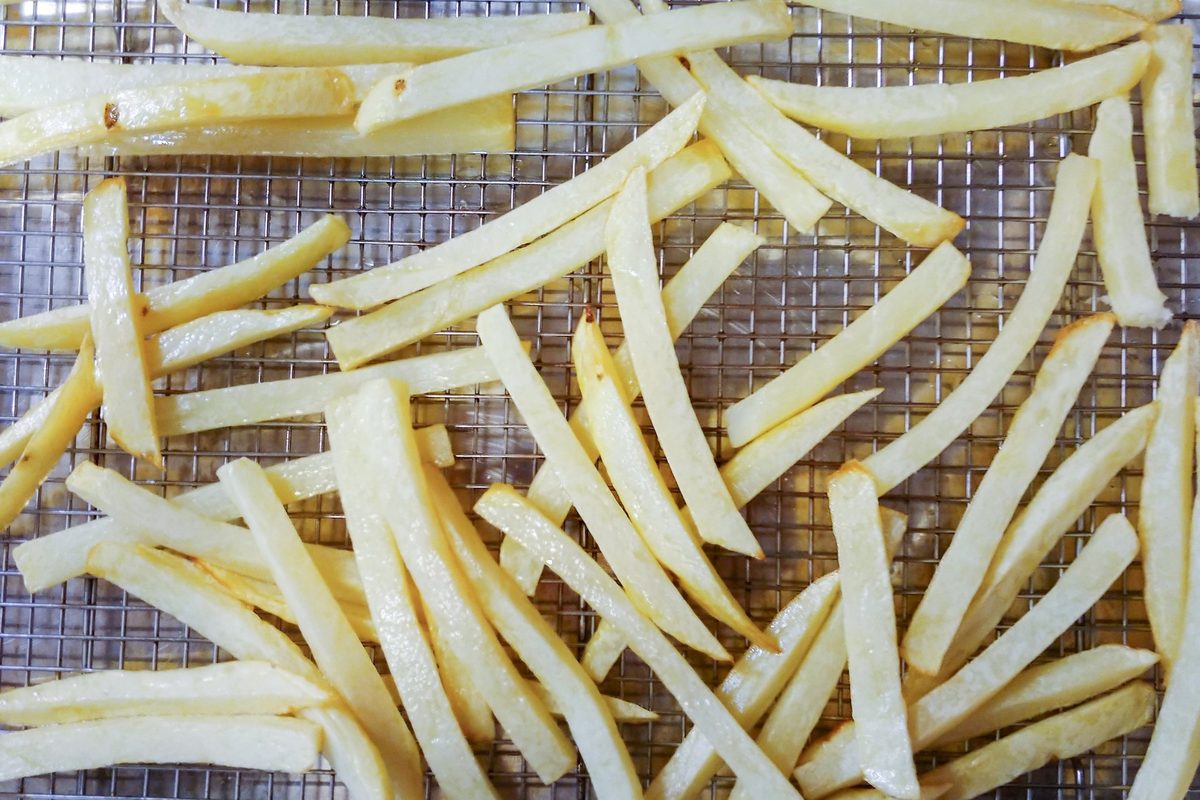
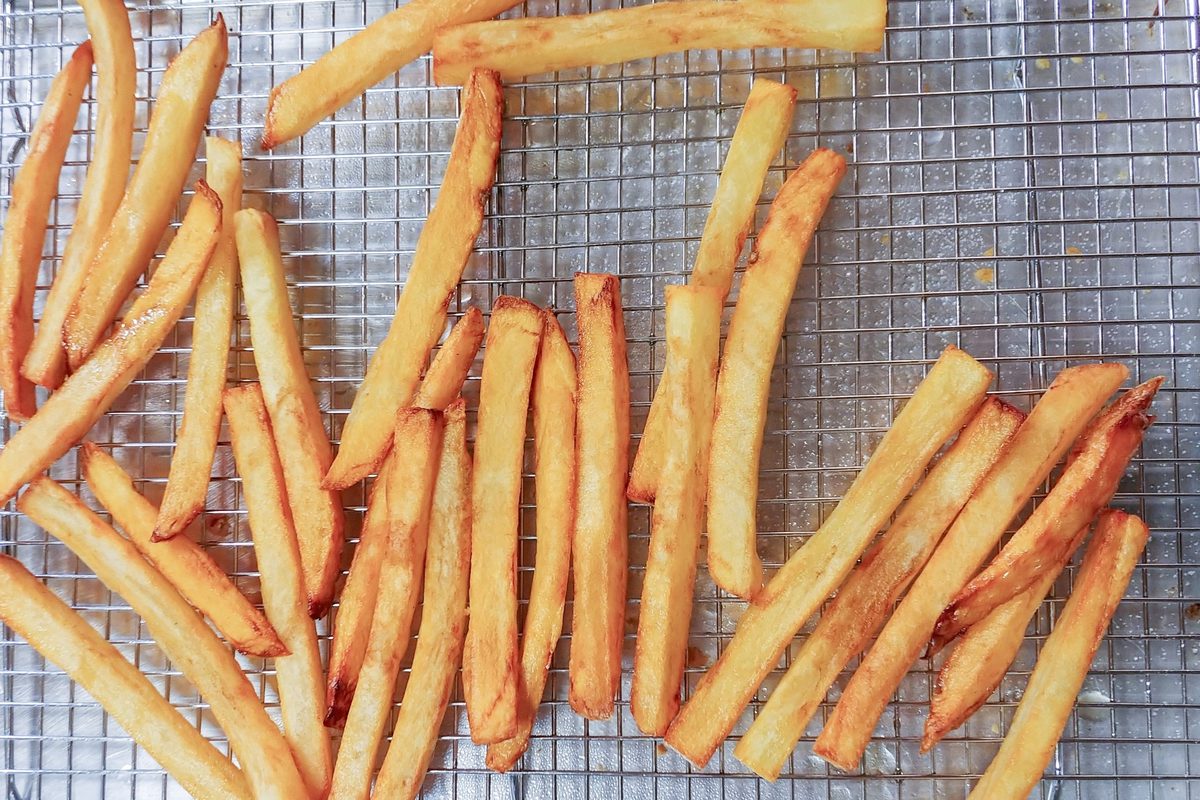
The key to crispy fries is the two-step frying process, and each step has its own job. First, preheat the oil to 300°F and fry until the fries are close to being cooked: they will look almost edible but still a little pale. That takes about 2 minutes for thin fries, 2 to 3 minutes for regular fries, and 4 minutes or more for steak fries. Then raise the oil to 370°F, and once it has truly reached that temperature, carefully lower the fries back in. Be extra careful on this second trip, because the fries are more fragile now than they were before the first fry. Take them out when they reach a golden color: 1 to 3 minutes for thin, 2 to 4 minutes for regular, 3 minutes or more for steak fries.

Fry in Batches So the Oil Stays Hot

For each of the two frying steps, work in batches. Dropping all your fries in at once pulls the oil temperature down, and oil that has lost its heat soaks into the potato instead of crisping it. How many batches you need depends on your equipment: splitting the fries into 2 batches is usually enough for a large or medium fryer, while a small fryer wants 3 or 4. This is also why I want a thermometer in the pot if you are not using a deep fryer with its own controls, so you can watch the temperature recover between batches.

The Right Pot and the Right Amount of Oil

You can make French Fries from Scratch in a deep fryer with frying oil, or in a 6 quart or larger pot holding 2 to 3 quarts of frying oil along with a thermometer for deep frying. The size matters: a generous pot gives the oil room to move and gives you a margin of safety when the fries go in. Alongside that, have your chef's knife and cutting board, a peeler, the medium bowl for soaking, plastic wrap, your two kitchen towels, a cooling rack or paper towels, and a large mixing bowl of about 8 quarts or more for the seasoning step. Having all of it set out before the oil is hot keeps the frying calm.

Drain, Then Season in a Big Bowl

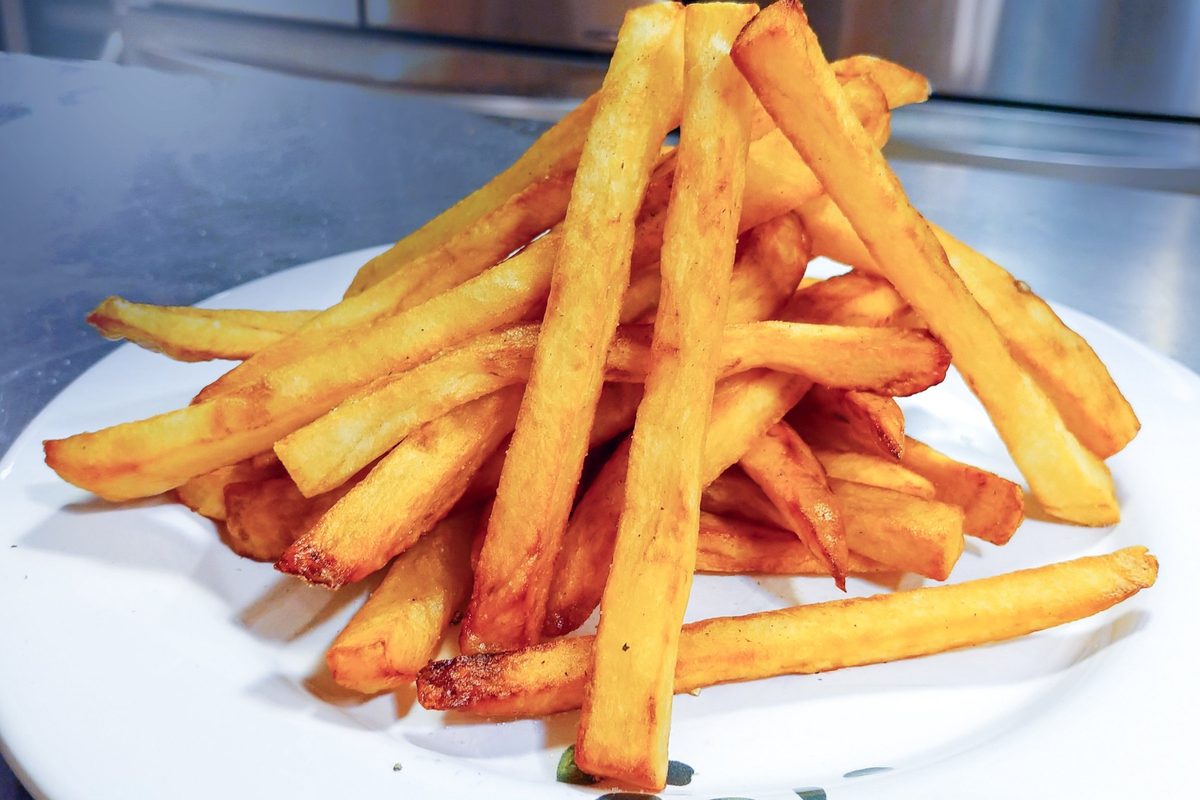
Straight out of the second fry, the fries go onto a cooling rack or paper towel for one minute to shed excessive fat. Then move them into the large mixing bowl, salt and pepper them generously, and mix thoroughly but gently, preferably by shaking the bowl rather than stirring, so the seasoning reaches every fry without breaking the crust you just built. Taste them and add more salt and pepper if they need it. Freshly ground pepper is worth it here, and this final touch is the difference between good fries and fries people keep reaching for.

Peel or Leave the Skin On

Start by briefly rinsing the potatoes under cold water, then cut off the ends, about three-quarters of an inch from each. From there you have a choice: peel them for a clean, classic fry, or leave the skin on if you are after a more rustic look. Both work in this recipe, so it comes down to the plate you want to put down. Make the decision before you start cutting, since it is much easier to peel a whole potato than a pile of cut fries.

Popular questions

What are the two temperatures I need for the two-step frying process?

Preheat your oil to 300°F for the first frying step, then increase it to 370°F for the second frying step.

French Fries from Scratch

4 servingsNEWPublished: 10.28.2026 ☆☆☆☆☆0x(write a review)👁9x
30 min.
3 ½ h.
1/5
🖨Print

Ingredients:

Click any ingredient to learn more
Final touch
Salt and pepper - ideally freshly ground
*Optionally, you can substitute it with any other kind of potato. Preferably use potatoes right after purchasing or soon after so they will have less sugar. While storing potatoes, the sugar naturally increases, and frying more sugary potatoes increases the risk of cancer.

Tools:

Click any tool to learn more
Medium Mixing Bowl (about 3 - 4 QT)
Deep Fryer with Frying Oil or 6 QT (or larger) Pot with 2 - 3 QT of Frying Oil and Thermometer for Deep Frying
Large Mixing Bowl (about 8 QT or more)

Nutrition per 1 Serving:(recipe split into 4 servings)

Estimated
Calories 215 Protein 6.0 g Fat 0.3 g Saturated fat 0.1 g Carbohydrate 48.6 g Sugars 2.4 g Fiber 5.2 g Sodium 32 mg Cholesterol 0 mg
VegetarianVeganGluten-freeDairy-free
Estimated. Worked out from the ingredients above using the United States Department of Agriculture’s FoodData Central reference data. An estimate, not a measurement — brands, sizes and how much of a marinade actually ends up on the plate all move it.
Directions:

1.Preparation:

Let’s start preparing the French Fries from Scratch!

1.1.

Briefly rinse potatoes under cold water.

1.2.

Cut off the ends of the potatoes (about ¾ inch) and peel (or leave the skin on if you are looking for a more rustic look).

1.3.

Cut potatoes into fries and try to reach an even thickness (for a more even fry).

1.3.1.

Thin fries with a thickness of about ¼" will be crispy all the way through.

1.3.2.

Regular fries with a thickness of about 3/8" will be crispy and have a little bit of a creamy part in the middle.

1.3.3.

Steak fries with a thickness of ½" or more will have a crispy outside and a decent amount of creaminess inside.

1.4.

Place cut fries into a medium bowl with cold water, cover with plastic wrap, and let rest in the refrigerator at least 3 hours, preferably overnight (to reduce the starch and reach perfect results).

2.Deep Fry and Serve French Fries from Scratch:

Important:

  • The key to crispy fries is a two-step frying process.
  • For each step, make it in batches to prevent an unwanted decrease in the oil’s temperature. The number of batches depends on the size of your deep fryer or pot. Splitting it into 2 batches should be enough for a large or medium fryer, and 3-4 for a small fryer.
2.1.

First frying step:

2.1.1.
Drain the water from your fries and dry them on a kitchen towel. Then let them dry on another dry kitchen towel while proceeding with the next step.

Important: Make sure the fries are completely dry before frying to prevent the hot oil from splattering.

2.1.2.

Preheat oil to 300°F.

2.1.3.

Then fry the fries until they are close to being cooked (they look almost edible but still a little pale):

•

2 - 3 minutes for regular fries

•

4 or more minutes for steak fries

•

about 2 minutes for thin fries

2.2.

Second frying step:

2.2.1.

Increase the oil temperature to 370°F.

2.2.2.

When the temperature is reached, carefully place fries into the fryer (be extra careful now as they are more fragile than before the first step).

2.2.3.

Fry until a golden color is reached:

•

1 - 3 minutes for thin

•

2 - 4 minutes for regular fries

•

3 or more minutes for steak fries

2.3.

Place fries on a cooling rack or paper towel for one minute to reduce excessive fat.

2.4.

Then place them into a large bowl, generously salt and pepper, and thoroughly (but gently) mix together (preferably by shaking the bowl).

2.5.

Taste and add more salt and pepper if needed.

French Fries from Scratch

Cook to safe temperatures and check for allergens. Nutrition values and results are estimates and may vary.

As an Amazon Associate I earn from qualifying purchases. Some of the ingredient and tool links above are affiliate links: if you buy through them the price is the same for you, and it helps keep these recipes free. #ad

Show moreShow less of the Disclaimer

Disclaimer

Last updated October 27, 2026

GENERAL INFORMATION

The content provided by Checked Solutions, LLC (doing business as Tom the Chef) ("we," "us," or "our") on https://www.tomthechef.com (the "Site") and through our related services — including recipes, articles, columns, live and recorded cooking classes, and other materials — is for general informational and educational purposes only and reflects the personal opinions and experience of the author. All information is provided in good faith; however, we make no representation or warranty of any kind, express or implied, regarding the accuracy, adequacy, validity, reliability, availability, or completeness of any information. Your use of the Site and your reliance on any information is solely at your own risk.

NO PROFESSIONAL ADVICE

Our content is not intended to provide, and does not constitute, professional dietary, medical, nutritional, or legal advice. Before making any health- or diet-related decision based on our content, consult a qualified medical or nutritional professional.

COOKING, FOOD SAFETY, AND YOUR RESPONSIBILITY

You are solely responsible for evaluating our recipes and instructions and using your own judgment before following them. To the fullest extent permitted by law, we are not responsible for any outcome or consequence resulting from your use of the Site or our content, including but not limited to:

  • Food Safety: any health risk related to food handling, food quality, cross-contamination, or failure to follow USDA recommendations (including minimum safe cooking temperatures).
  • Preparation Safety: the safe handling of cooking equipment, hot surfaces, sharp knives, or the suitability of tools for any task.
  • Allergies and Dietary Restrictions: any allergic reaction or health issue arising from ingredients in our recipes. You are responsible for ensuring that all ingredients and methods are safe and appropriate for your dietary restrictions, allergies, and health.
  • Recipe Outcomes: the final look, taste, yield, or success of a recipe, which may vary based on ingredients, equipment, oven temperatures, altitude, humidity, and skill.
  • Ingredients and Equipment: the sourcing, quality, and condition of ingredients, tools, or equipment.
  • Nutritional Information: the accuracy of any nutritional data, which is an estimate provided as a courtesy and should not be relied on as a guarantee.
  • Errors and Omissions: any errors, typos, or unclear directions in our content.

EXTERNAL LINKS

The Site may contain links to third-party websites or content, including in banners or other advertising. We do not investigate, monitor, or guarantee the accuracy or reliability of third-party sites. We are not responsible for them or for any transaction between you and a third party. Accessing third-party sites is at your own risk.

TESTIMONIALS, REVIEWS, AND COMMENTS

The Site may contain testimonials, reviews, and comments from users. These reflect the personal experiences and opinions of individual users and may not be representative of all users; your individual results may vary. Testimonials and reviews may be shortened for brevity or corrected for grammar. The views expressed belong solely to the individual. They are not intended as claims that our products or services diagnose, treat, cure, or prevent any disease or medical condition.

CONTENT OWNERSHIP

All content published by Tom the Chef is the intellectual property of Checked Solutions, LLC and its author, unless otherwise noted, and may not be used except as permitted in our Terms of Use.

AFFILIATE DISCLOSURE

As an Amazon Associate, we earn from qualifying purchases. Some ingredient and tool links on the Site are affiliate links. If you buy through them, the price is the same for you, and it helps support our content. We only recommend products we genuinely use and trust.

LIMITATION OF LIABILITY

Under no circumstances shall Checked Solutions, LLC or Tom the Chef have any liability to you for any loss or damage of any kind incurred as a result of the use of the Site or reliance on any information provided. This Disclaimer forms part of, and is subject to, our Terms of Use.